Travel Booking Software Development: Features, Architecture, Cost & Roadmap
30 Oct 2026If you look at a travel booking website, it appears to be straightforward – you click to search, select a travel package, make a payment, and get a confirmation. In the background of that trip lies a much more challenging software issue.
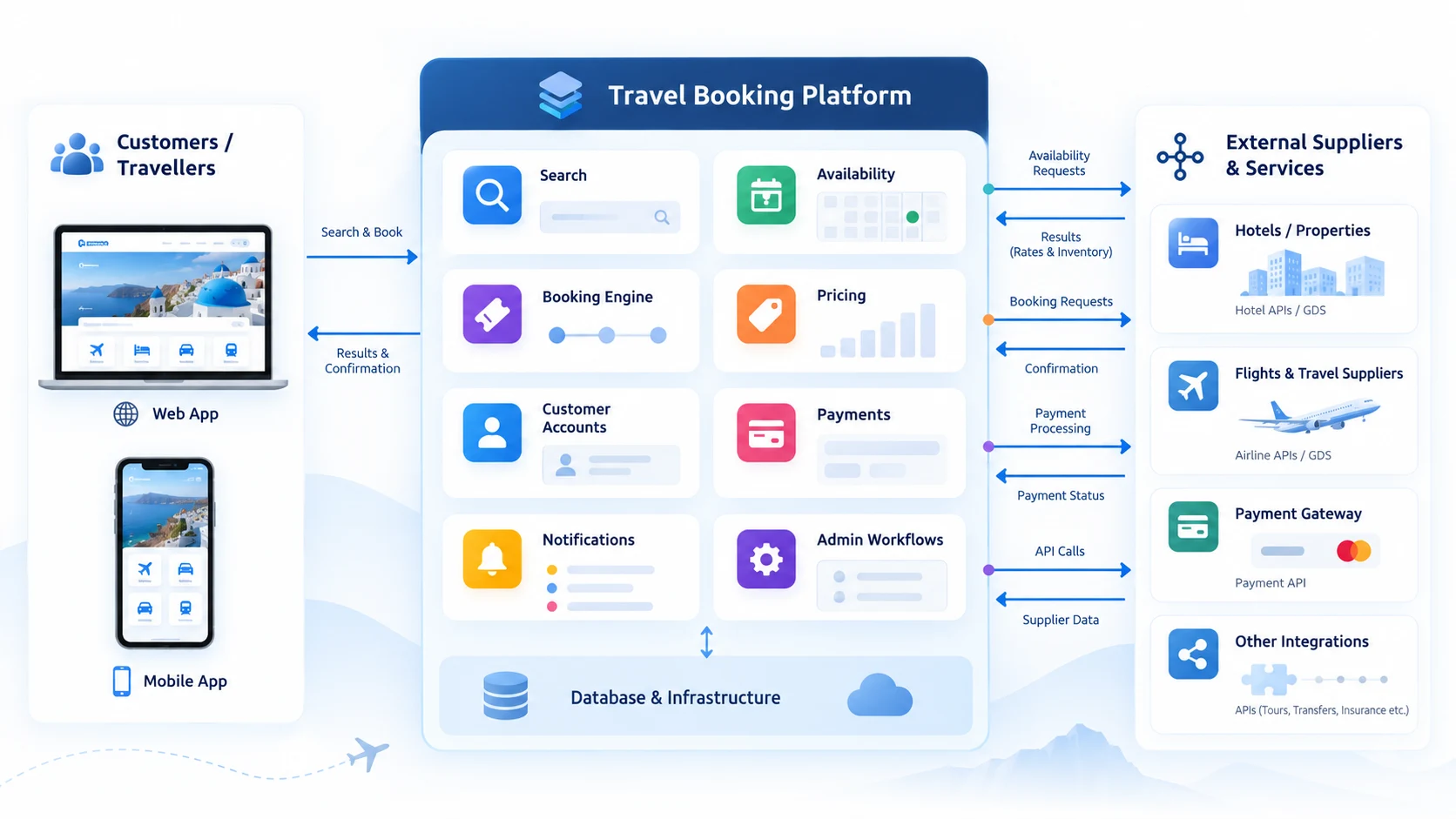
A production travel platform may need to integrate live inventory, pricing, availability, customer accounts, payments, cancellations, supplier integrations, notifications, and administrative workflows—and ensure that the traveller does not feel these layers of complexity.
This is why it is necessary to begin with architecture and operations when developing travel booking software successfully, instead of screens.
The first question that any hotel chain, tour operator, OTA, or travel-tech startup should ask is not “Which framework shall we use?” It should be: “What booking process should we have in our own system, and what parts should be externalized?”
What Does Travel Booking Software Need to Do?
At a minimum, there needs to be a dependable path from discovery to fulfilment for a booking product.
A hotel platform will require destination and date search, room inventory, rate plans, promotions, guest information, payment, confirmation, and modification flows. An OTA may need to integrate data from multiple sources, ensure consistency across data sets, and return uniform data. Packages, transfers, activities, and manually controlled allocation may be required for a tour operator.
The error is considering them all as different versions of the same website.
The actual transaction lifecycle should be the starting point for your product requirements:
Search, availability, selection, traveller details, price validation, payment, reservation, confirmation, servicing, change/cancellation.
Travel-development specialists also highlight real search, reservation, cancellation, and servicing procedures, with an emphasis on the front-end booking interface.
Core Features to Define Before Development
Use the simplest set of capabilities that results in a viable booking system.
For products that customers interact with, this usually involves search and filtering, availability, account or guest checkout, booking summary, secure payment, confirmation, and self-service booking management.
The operator side is no different. Administrators will require inventory control, pricing rules, cancellation policies, refunds, supplier mapping, promotions, customer support tools, reports, and role-based permissions.
The product may also be integrated with property management and channel systems for hotels. For agencies and OTAs, supplier connectivity is typically built into the platform.
Try not to put “admin panel” as one of the requirements. Identify the decisions an administrator must make and the information needed to make those decisions.
Architecture and Integrations
A bookable system is normally best served by having a separate user interface, booking/business logic, integration layer, and operational data.
The front end handles the checkout, sales, and search processes. Core services enforce rules around users, bookings, pricing, and payments. An integration layer helps keep external inventory or hotel databases separate, so that changing one supplier won't require rewriting the entire application. Your customers, reservations, rules, and audits are stored in databases.
This separation is particularly useful when there are more suppliers.
External availability should also be handled separately from your own durable records. Fare or room prices are subject to change between the search and checkout processes, and the system must revalidate the transactional information prior to payment or final reservation.
Payments, Security and Reliability
Data that customers expect to be protected is handled by a booking platform. It is therefore important that security is part of the design process, not a pre-launch checklist.
Limit the risk of handling raw payment-card data by using trusted payment providers and tokenised payment patterns. Use robust authentication for administrative accounts, encrypt sensitive data, assign permissions based on role, and keep track of sensitive operational actions in audit logs.
It is also important for travel systems to exhibit graceful failure behaviour. What happens if the supplier times out after payment? If the reservation succeeds externally, but your confirmation service fails, what happens? How does the support agent view, process, or reconcile ambiguous bookings?
Custom Build, SaaS or Hybrid?
It's not necessary to construct everything.
If your workflow is standardized, time to market is a priority over differentiation, and the integrations available cover your operations, then a SaaS booking tool could be the correct answer.
Custom development becomes more appealing when your competitive edge is based on proprietary workflows, unusual supplier deals, unique pricing models, more complex B2B/B2C dynamics, or when you need data ownership or a customer experience that isn't possible with packaged software.
The logical approach for many businesses is to create the unique aspects of the experience and workflows, and purchase commodity services like payments, messaging, and infrastructure.
What Does Travel Booking Software Cost?
No single price can be quoted for a booking platform you can count on. First, the cost varies depending on the number of suppliers, booking complexity, mobile needs, payment processes, user roles, data transfer, security, UI sophistication, and operational tools.
A travel product that has many real-time suppliers, complex pricing, and a high number of transactions can quickly grow beyond the basics of a web-app budget range.
So, the most effective way to control cost is not to eliminate QA or architecture work. It is to focus on a narrower initial commercial release.
A Practical Development Roadmap
Start with discovery: users, suppliers, bookings, payments, support, and failure scenarios.
Then, mock up the customer journey and test it with actual users or booking staff. Concurrently, demonstrate the most volatile integration technically.
Next, create an MVP for just one full booking process instead of 10 partial booking processes.
Prior to launch, check for supplier failures, duplicate entries, price changes, payment mistakes, refunds, permissions, and mobile behaviour.
As the workflow settles in, introduce suppliers, personalisation, loyalty, AI assistance, and more channels when they have been proven to be useful.
Build for the Booking Journey You Actually Own
Travel software is only effective if it's able to reconcile with the reality of the business.
The best platform is not the one with the most features. It is the one that can consistently get a customer from the thinking stage to the booking stage—and give your staff sufficient control to handle exceptions when things go wrong.
Trawlii designs tailor-made travel platforms, hospitality and travel portals, mobile experiences, and modernisation solutions. First, visualise the workflows, integrations, and scale your initial release needs to accommodate, and then work the design around that.